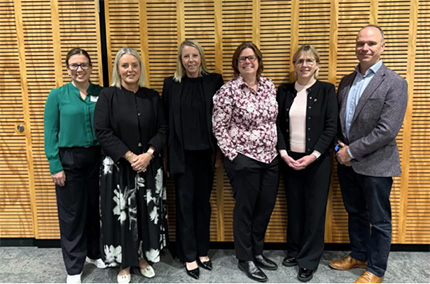
Women in Supply Chain leading the way in industry networking
Posted: 15-May-2026 |
This week I had the privilege of attending a Women in Supply Chain (WISC) breakfast networking event, to join a panel discussion with National Road Carrier member WM’s Ingrid Cronin Knight.
And what a great event it was. There was a real buzz in the room, it was a warm welcoming environment with everyone clearly enjoying getting together from all corners of the supply chain. I was impressed to see that a session was set up to practice in person the skill of networking – how to break into groups, introduce yourself and ask questions. All in a safe environment.
As we all know, the women in supply chain still number too few. It is an operationally intensive environment and usually male-dominated, so building relationships can be challenging. So WISC was set up by some dedicated volunteers to help build not just networks, but friendships across the supply chain.
I really enjoyed the experience of joining over 100 women from across the industry to talk about the great work National Road Carriers does on behalf of our members. It was pointed out to me that I was literally the only male in the room, something I hadn’t actually noticed, probably to do with the fact I was lucky enough to grow up with three older sisters.
In the panel discussion, Ingrid talked about Waste Managements electric truck fleet for kerbside pick-ups – they have the largest electric vehicle workshop in the southern hemisphere. Right now, with the diesel price shock, WM taking the risk in early investment is clearly paying dividends.
And yes, the Iran conflict was a hot topic. I talked about NRC’s work with government officials to help craft a practical response that supports industry to navigate the impacts.
What stands out is how the Government is listening. They have a consistent message to industry – tell us what government can do to help. Their expectation is that those in industry are best placed to respond, they are the experts closest to the day-to-day who know how to manage their operations. Government’s role is to remove any roadblocks. This is a stark contrast from the Covid-19 pandemic, where the Government’s instinct was to control industry rather than seek their expertise, and to tell more than listen.
The Fuel Response Plan released this week is an excellent example of how to work constructively with industry.
The plan was dusted off in March, officials sat down with industry representatives and asked us how practical the plan was. The existing plan involved being able to classify a whole lot of bands of business types and activities across the entire economy, in order to inform who gets and who doesn’t get fuel should major shortages occur.
It quickly became apparent that the plan was unworkable. So we went back to the drawing board. Government asked major fuel users, supply chain and fuel companies what would work. For supply chain, we advised that any classification process for priority fuel users would have to be broad enough that unpicking critical freight from non-essential freight wasn’t required. It simply is not possible to do. That lesson was learned the hard way in the bad old days of the Covid-19 Auckland border.
The revised plan released this week is a great example of government and industry working together to come up with practical, realistic plans that are workable in the real world.
While there has been no fuel supply shortage, and supplies remain robust, industry still asked that a workable way to allocate fuel must be developed so we are ready should the unthinkable happen. The new plan strikes the balance between the extremes of an overly-controlled policing of fuel access (simply not practical) and a hands-off high-trust model.
A bit like us in the supply chain, the Government’s response to the Iran conflict has been to focus on what matters, get the job done and ignore the noise.
Thank you to Deena Clarkson and the team organising WISC for inviting me along, and running such a great initiative. Keep up the great work.
Justin Tighe-Umbers, Chief Executive, National Road Carriers Assn
Search Articles
Search Trucks Database
NZ Truck & Driver Magazine
Read Now


 + EQUIPMENT GUIDE - FREE