Tata Motors and Iveco Unite to Create a Global Commercial Vehicle Powerhouse
Posted: 05-Nov-2026 |
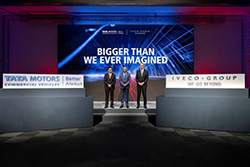
Tata Motors and Iveco Group have officially joined forces, creating a major new player in the global commercial vehicle industry, with a combined presence in more than 130 countries.
The combination of Tata Motors and Iveco Group marks the beginning of a new chapter for both manufacturers, bringing together complementary vehicle portfolios, engineering expertise and global distribution networks to create what they describe as a new global commercial mobility enterprise.
Announced at a global press conference in Turin, Italy, the combined business ranks fourth among the world's commercial vehicle manufacturers, with annual sales volumes of approximately 590,000 units and combined revenues of around €21 billion (INR 2.28 trillion).
The scale of the operation is considerable, bringing together more than 73,000 employees, 27 manufacturing facilities, 25 research and development centres and a network of approximately 9,300 sales and service locations worldwide.
The partnership combines Tata Motors' strong presence in India and emerging markets with Iveco's established positions across Europe and Latin America. Its collective portfolio covers everything from light commercial vehicles and heavy trucks to city and intercity buses, alongside powertrain technologies through Iveco's FPT business.
Importantly, both companies intend to retain their individual brand identities and industrial foundations. Iveco Group will remain headquartered in Turin, Italy, with its existing brands, teams and operations continuing under their established structures.
For customers, the companies say it will be business as usual, with existing contracts, warranties, dealer relationships, supplier arrangements and aftermarket commitments continuing unchanged.
Looking ahead, the combined enterprise plans to accelerate development across a broad range of powertrain technologies, including conventional combustion engines, natural gas, battery-electric and hydrogen solutions.
Tata Sons Chairman N Chandrasekaran described the move as an opportunity to combine two established organisations and shape the future of commercial transportation through greater scale, technology and investment.
For the commercial vehicle industry, the coming together of these two manufacturers represents a significant shift in the global landscape. The immediate priority is maintaining continuity, but the longer-term ambition is to use their combined engineering capabilities, manufacturing strength and market reach to deliver the next generation of commercial mobility solutions.
In short, two major commercial vehicle players have become a considerably bigger force, and the industry will be watching closely to see what they build together.
Search Articles
Search Trucks Database
NZ Truck & Driver Magazine
Read Now


 + EQUIPMENT GUIDE - FREE