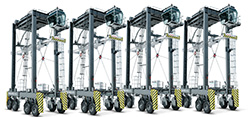
Port Otago is investing $28m in 10 new straddle carriers
Posted: 03-Sep-2026 |
Straddle carriers are the large mobile machinery that lift, transport and stack fully-laden shipping containers into rows on the Port Chalmers Container Terminal. The terminal’s current fleet of 14 straddle carriers has an average age of 17 years. Ten are diesel fuelled and four are diesel/electric#. The 10 new Konecranes Noell hybrid straddle carriers will replace the 10 diesel machines, when they arrive in August 2027.
Hybrid straddles represent 90-95% of current world-wide straddle production, and the Konecrane model is capable of being converted to fully electric or hydrogen when these alternative fuels become economically viable.
Port Otago Chief Executive Kevin Winders says new straddles are a significant step up for the company’s drivers, who will benefit from the improved ergonomics and visibility, supported by modern on-board systems, such as 360-degree cameras. “The new straddles will be connected in real-time to Port Otago’s systems, providing accurate positioning and activity data points for each straddle. These features are prerequisites for the introduction of new routing software to improve productivity, reduce waste and ultimately support autonomous operations.”
Mr Winders says that, while the investment is significant financially, it is also significant strategically. “The Port Chalmers Container Terminal’s existing mobile plant was near the end of its life, which presented the company with a once-in-a-lifetime opportunity to change the terminal’s operating mode. We conducted a comprehensive review of what the terminal’s future should look like.
“The straddle carrier replacement is just one part of that review. It dovetails into the terminal’s $12.5 million rail pad investment that will connect the terminal to Southern Link inland port. It also sits alongside our $30 million development of Dunedin Bulk Port for log storage, and the $23 million extension of the Multipurpose Wharf back in 2019.”
Mr Winders says these investments focus on three key strategies. “Being big-ship capable, creating landside space to grow and transitioning the container terminal to be data-led.
“We just achieved 14m chart datum in the Otago Harbour lower channel, so we are now capable of berthing up to 10,000 TEU vessels. We need more landside space to service our region’s exporters and Southern Link inland port will provide that. Now, our container terminal operations are being modernised to be a safer and more efficient operation.”
Mr Winders says the advantages of the new fleet are substantial and immediate. “The straddles will use 35% less diesel – that’s around 190,000 litres per year – than the 10 diesel machines and ongoing maintenance costs will be half. The new machines will also offer significantly improved up-time availability and deliver improved productivity by lifting our gross crane rate*. This, in turn, will lift our service levels to shipping lines.”
Konecranes Sales Director Peter Kania says his company is looking forward to supporting Port Otago’s renewal of its container handling fleet. “Our hybrid straddle carriers, digital fleet management tools and experienced service technicians in Australia and New Zealand will help deliver higher productivity, lower total cost of ownership and long-term operational reliability.”
The remaining four diesel/electric straddles are an average of 10 years old and operate on a different technology. They will be reconditioned to extend their operating life, before also being replaced (scheduled for 2031).
Search Articles
Search Trucks Database
NZ Truck & Driver Magazine
Read Now


 + EQUIPMENT GUIDE - FREE