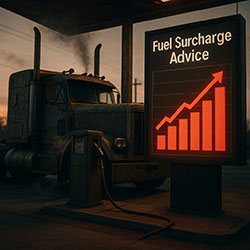
ComCom Guidance - businesses applying fuel surcharges and FAF
Posted: 23-Apr-2026 |
ComCom advise businesses to regularly review their surcharges to ensure they remain accurate and justified, and to engage with us early and follow our guidance to ensure compliance with the Fair Trading Act.
While fuel surcharges can be a legitimate way for businesses to recover unexpected increases in fuel costs, we want to remind businesses about how to apply them fairly.
Fuel surcharges must reflect only the additional fuel costs your business is facing and cannot be used as an excuse to recover unrelated expenses or to increase margins. Any surcharge should be based on real and current cost pressures.
If you do need to add a fuel surcharge, your customers must be informed of any surcharges before payment, in line with Fair Trading Act guidance. This includes making the surcharge easy to see, understand and factor into purchasing decisions.
Under the Fair Trading Act it is illegal to make an unsubstantiated representation about a good or service without any reasonable basis. It is also illegal to make false or misleading representations with respect to the price of any goods or services.
Don’t make a fuel surcharging claim if you don’t have reasonable grounds for believing it to be true.
Many transport and freight operators use a pricing mechanism called the Fuel Adjustment Factor (FAF) to manage fuel price volatility. It is important to understand what this is and how it differs from surcharges.
A FAF is a commercial pricing mechanism allowing operators to pass through increases or decreases in fuel costs to customers in a transparent way instead of constantly changing baseline prices.
It moves up and down with fuel prices, is set individually by companies and it typically appears as a separate line item on quotes or invoices.
If your business is utilising a FAF you should ensure you are communicating openly and clearly with your customers about how your pricing mechanism calculates it. Your customers need to understand how the prices you charge respond to fuel price movements and should have confidence that your pricing is aligned with those movements.
As fuel costs go down we expect any surcharge or FAF to reflect this reduction in cost.
Search Articles
Search Trucks Database
NZ Truck & Driver Magazine
Read Now


 + EQUIPMENT GUIDE - FREE